900 Saint-Jacques: Between Past, Modernity, and Mobility
2026.01.05
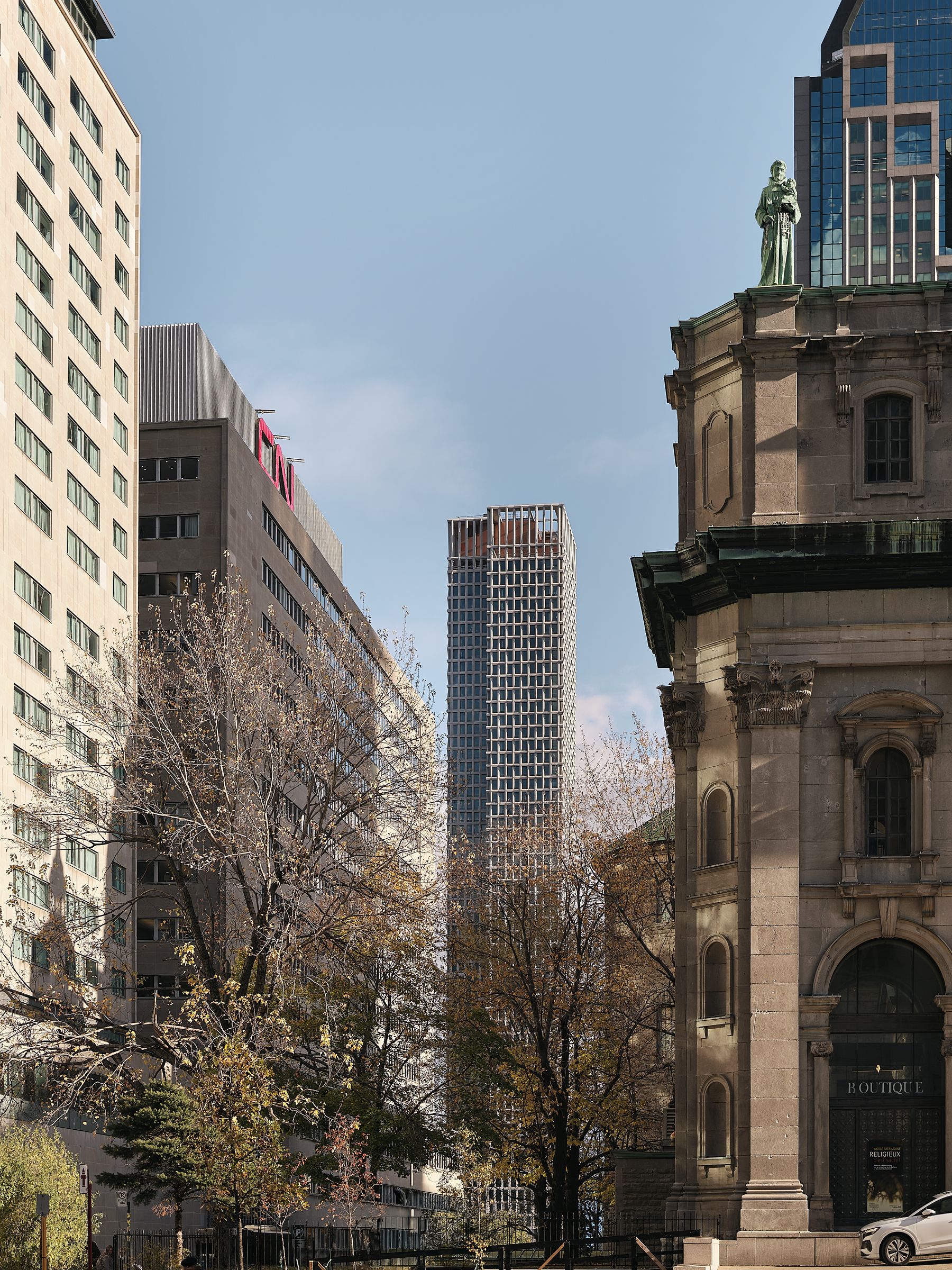
The 900 Saint-Jacques tower rises within a landscape shaped by infrastructure, animated by the continuous movement of trains and automotive flows. At the heart of the rapidly evolving Quartier des gares, the tower rises on a site once considered residual, shaped by the Ville‑Marie Expressway and railway lines. Today, it has been reimagined as a vibrant crossroads of sustainable mobility.
Conceived as a contextual response to a territory long dominated by highways and rail infrastructure, the tower proposes a way of living that combines environmental performance, urban density, and careful attention to collective spaces. The project arrives at a pivotal moment, as contemporary approaches to housing, mobility, and materiality are being redefined in a northern climate. Recently completed, the tower brings to fruition an ongoing reflection developed over several years at the core of the Quartier des gares.
900 Saint-Jacques: A Lived Intersection Between City, Infrastructure, and Northern Climate
900 Saint-Jacques marks a new chapter in Chevalier Morales’ ongoing exploration of housing in dense urban environments. The project is situated on a site historically shaped by rail lines and the Ville-Marie Expressway, long perceived as a marginal space at the edge of downtown. Today, this former void is transforming into a lived intersection where sustainable mobility, memory, and new ways of inhabiting the city converge.
Envisioned from the earliest sketches as a building rooted in its geographic and climatic context, 900 Saint-Jacques offers a vision of housing that addresses environmental challenges, social realities, and the distinct identity of Montréal. Positioned at the Bonaventure Gateway, in a sector poised to become a benchmark for sustainable mobility, the tower fully embraces its role as a pivot, mediating between infrastructure, an emerging neighborhood, and the metropolitan skyline.
A Site at the Convergence of Mobility Networks
The project benefits from an exceptional location at the junction of the REM, the métro, commuter rail lines, bus routes, and an extensive pedestrian network connecting downtown and Old Montréal. A future bike path along Saint-Jacques Street, running at the base of the building, further strengthens the area’s multimodal character. The tower leverages this strategic location to encourage a shift toward public and active transportation.
This ambition is reflected in the integration of a cyclist rest stop, indoor and outdoor bicycle parking, electric vehicle charging stations, and spaces dedicated to car-sharing. In doing so, the project extends the site’s railway legacy while contributing to the redefinition of the Quartier des gares as a vibrant hub of sustainable mobility.
A Mineral Architecture Inspired by Montréal’s Built Heritage
Echoing the glass towers of downtown while reasserting a mineral tradition, 900 Saint-Jacques reconnects with a Montréal once shaped by stone and brick. Its envelope of sculpted prefabricated concrete panels reinterprets the city’s emblematic cruciform motifs, forming a mineral weave that responds subtly to solar orientation. Openings of measured proportions are modulated across façades to limit heat loss, while loggias are primarily oriented south and west to mitigate overheating during the summer months.
This textured envelope reaffirms the city’s northern identity while asserting a contemporary aesthetic born of environmental and energy efficiency considerations. As daylight shifts, the façade’s relief comes into focus, offering a nuanced and evolving reading of the tower ; one that enters into dialogue with the historic façades of Old Montréal, the podiums of Place Ville Marie and the Sun Life Building, and the monumental constructions of the Olympic Park.
Massing and the Urban Landscape
The tower is classically articulated into three layers: a base, a shaft, and a crown. Each is paired with a distinct green space that engages different urban scales: the street, the neighborhood, and the metropolitan landscape. At ground level, a garden linked to the restaurant terrace and the bike path contributes to the greening of the sector and aligns with the green spaces outlined in the Quartier des gares’ urban planning framework. At the podium level, planted terraces form a suspended garden establish a clear transition between base and tower. At the top, an elevated green space opens toward Mount Royal, placing the tower in direct dialogue with the mountain it equals in altitude.
The massing was carefully refined to slim the tower’s north and south profiles, creating a slender silhouette when viewed from the Bonaventure Esplanade and the REM and rail arrival points, while minimizing visual impact from Mount Royal. Slightly shifted westward, the tower partially recedes behind 1000 De La Gauchetière from certain angles, softening its presence in the skyline. The base, meanwhile, establishes a close relationship with Saint-Jacques Street and the rail viaduct through a generous cantilever and glass canopy that shelter pedestrians, visitors, and residents alike, firmly anchoring the project in urban life.
Collective Spaces and Community Life
Beyond formal and technical considerations, 900 Saint-Jacques proposes a vision of housing in which collectivity plays a central role in shaping a complete living environment. The project’s configuration encourages interaction by multiplying shared spaces and creating meeting places accessible to both residents and visitors of the integrated Moxy Hotel.
Terraces, gardens, a restaurant, community spaces, a shared kitchen, coworking areas, lounges, and other common amenities extend the residential units and support a wide range of activities throughout the day and evening. These transparent, light-filled volumes stand in contrast to the mineral envelope, making the building’s social life visible from the exterior. Acting as the tower’s breathing cells, they aerate its massing and foster a community dynamic rooted in shared space, time, and use.
Sustainability and Social Diversity
The sustainable approach of 900 Saint-Jacques unfolds across both environmental and social dimensions. From an energy perspective, the high-performance envelope, combined with electromechanical strategies, targets energy efficiency beyond baseline standards, drawing inspiration from certification frameworks such as LEED. Modulated openings, the use of local materials, water-saving measures, and efficient lighting systems all contribute to reducing the building’s environmental footprint.
Socially, the project places strong emphasis on families and a diversity of resident profiles. The proportion of family-sized units is increased, with a significant offering of three-bedroom apartments and flexible units adaptable over time. Smaller units, inspired by the logic of “mini-homes,” reflect evolving consumption habits and provide more affordable access to downtown living, balanced by a rich array of high-quality shared spaces.
With 900 Saint-Jacques, Chevalier Morales and Architex deliver a building that expresses the complexity of its site and its time: a contemporary mineral architecture rooted in Montréal’s built heritage, oriented toward sustainable mobility, and attentive to the lived experience of its inhabitants. Bridging past and present, the tower redefines a key gateway to the city while embodying a sensitive and tangible vision of housing within Montréal’s urban landscape.
At a moment when Montréal seeks to reconcile architectural heritage, real estate pressures, and ecological transition, 900 Saint-Jacques positions itself as a thoughtful contribution to this collective reflection, demonstrating that it is possible to build a tower capable of engaging with the city of yesterday, the infrastructures of today, and the ways of living of tomorrow.